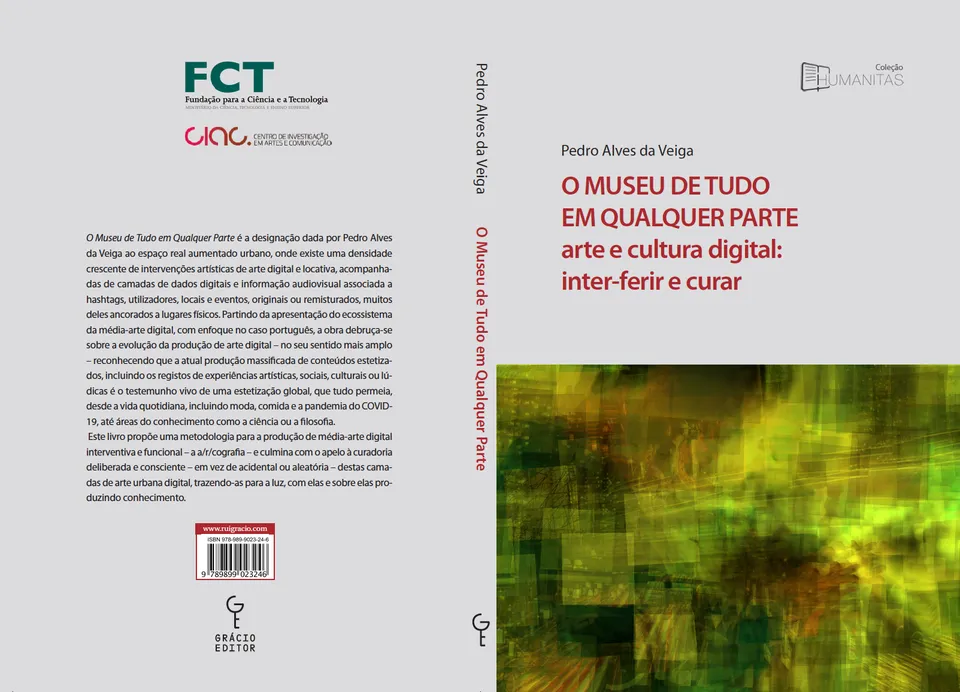
On completing my doctoral thesis "Experiência e Atenção: Construção e Constrição de Ecossistemas de Média-Arte Digital" (Experience and Attention: Construction and Constriction of Digital Media Art Ecosystems), in the PhD in Digital Media Art at Universidade Aberta and the University of the Algarve, the idea arose of turning it into a format more accessible to a global, not necessarily academic, readership.
Adapting and expanding the thesis into this format grew out of continued research and publication in journals and conferences, from which emerged the concept of the "Everywhere Museum of Everything": the global exhibition formed by digital layers that mirror contemporary culture, invisible to the human eye without technological mediation, yet inhabiting all the space crossed and augmented by our mobile devices, where there is a growing density of digital and locative art interventions alongside a mass production of aestheticised content. In these layers we find digital data and audiovisual information associated with hashtags, users, places and events, original or remixed, many of them anchored to physical places, including the records of artistic, social, cultural or recreational experiences.
They are the living testimony of a global aestheticisation that permeates everything, from everyday life, including fashion, food and the COVID-19 pandemic, to fields of knowledge such as science or philosophy.
The production of these digital artefacts may result from conscious, deliberate processes, but also from the automatism we have developed in using technology, from the way we live online in social networks, and from the Internet of Things, whose popularity and capacity keep growing.
Because creating an exhibition in a museum involves many different processes, from inventory, cataloguing and curating to production, which includes designing exhibition, interpretive and communication devices, it seemed fitting to organise this book according to the criteria that might guide the conceptual and pervasive EME (MTQP), in the hope that reading it may give new meaning to its exploration – and enrichment.
Accordingly, the book is divided into four parts – Collection, Methodology, Exhibition and Museum – covering three steps that lead to the construction of the final concept, and concluding with that concept.
The first part – Collection – lists the various agents of the Digital Media Art (DMA) ecosystem, with particular attention to the Portuguese ecosystem, as well as the varied kinds of relationship that can be found among them.
The second part – Methodology – suggests ways of producing DMA artefacts in parallel with their own research and documentation, a process that enriches and amplifies knowledge of digital artworks, giving them artistic, aesthetic, historical, cognitive, psychological, technological, social and economic contexts, among others. This part of the book is aimed mainly at students and scholars in the field, and at artists and creators who wish to document their creative process. It also lays the groundwork for an objective assessment of the positioning of digital media artworks, namely considering aspects of intention/intervention at the aesthetic, functional and craft levels.
The third part – Exhibition – illustrates several contemporary approaches to intervening in society through the public exhibition and availability of DMA artefacts.
The fourth part embodies and defines the Everywhere Museum of Everything, suggesting ways of interpreting and visiting it, but also of developing it consciously, through interventive artistic creation, or through research, analysis, exploration and reuse/remixing of the existing collection.
On behalf of the Everywhere Museum of Everything, I thank you for your visits and contributions, even if you had not noticed them until now.
I thank the supervisors of my doctoral thesis, Mirian Tavares and Heitor Alvelos, and everyone who followed this process from its inception and who made it possible and encouraged it, directly and indirectly, especially José Marques, Lurdes Paz, Adelaide Pegado and Susana Mendes da Silva. Heartfelt and special thanks to all the DMAD lecturers, and in particular to Adérito Marcos.
https://bibliografia.bnportugal.gov.pt/bnp/bnp.exe/registo?2066584