A piece in the Principium series.
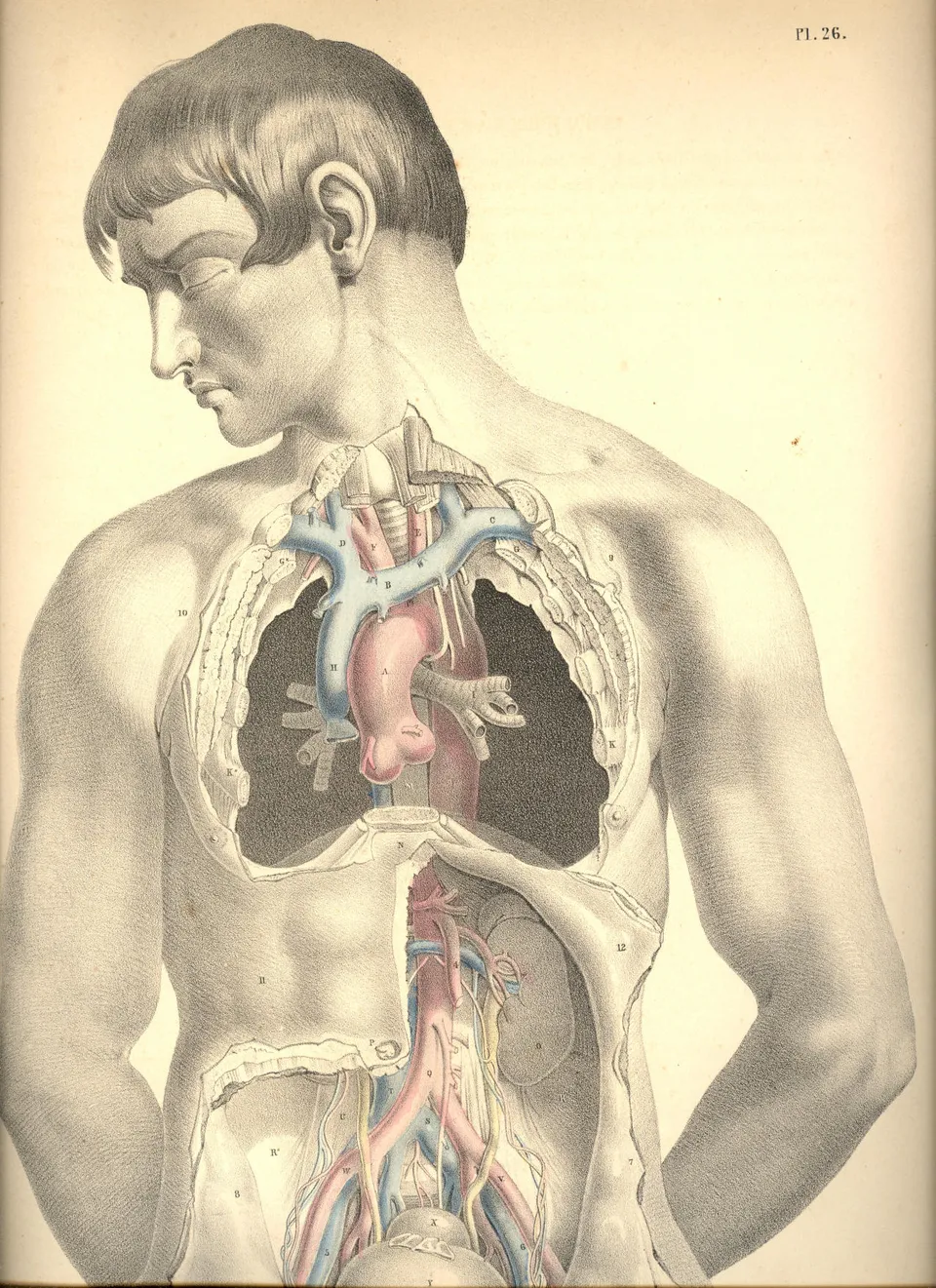
A. The systemic aorta. Owing to the body being inclined forwards, the root of the aorta appears to approach too near the lower boundary (N) of the thorax.
B. The left brachio-cephalic vein.
C. Left subclavian vein.
D. Right brachia-cephalic vein.
E. Left common carotid artery.
F. Brachio-cephalic artery.
G G*. The first pair of ribs.
H. Superior vena cava.
I. Left bronchus.
K K*. Fourth pair of ribs.
L. Descending thoracic aorta.
M. Oesophagus.
N. Epigastrium.
O. Left kidney.
P. Umbilicus.
Q. Abdominal aorta, at its bifurcation.
R R*. Right and left iliac fossae.
S. Left common iliac vein.
T. Inferior vena cava.
U. Psoas muscle, supporting the right spermatic vessels.
V. Left external iliac artery crossed by the left ureter.
W. Right external iliac artery crossed by the right ureter.
X. The rectum.
Y. The urinary bladder, which being fully distended, and viewed from above, gives it the appearance of being higher than usual above the pubic symphysis.
Z. Pubic symphysis.
2. The left internal abdominal ring complicated with the epigastric vessels, the vas deferens, and the spermatic vessels.
3. The right internal abdominal ring in connection with the like vessels and duct as that of left side.
4. Superior mesenteric artery.
5, 6. Right and left external iliac veins.
7, 8. Situations of the anterior superior iliac spinous processes.
9, 10. Situations of the coracoid processes.
11, 12. Right and left hypochondriac regions.