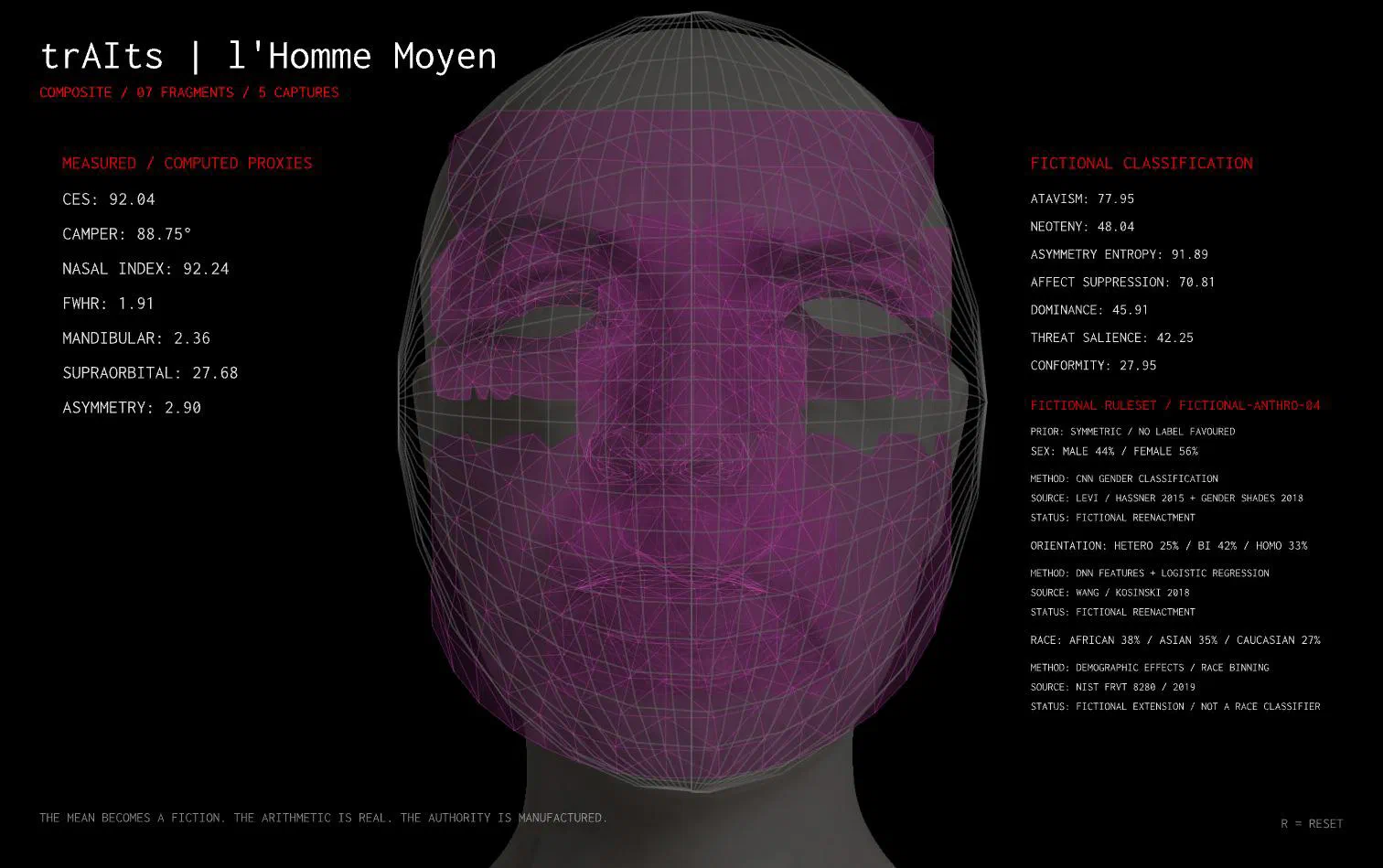
trAIts | l'Homme Moyen is an interactive installation-performance in three acts on facial inference: the claim that character, gender, sexual orientation, criminal propensity or risk can be read from a face. Identification asks "who are you?"; inference asks "what are you?". A camera measures the faces of a few volunteers, builds a composite "average man" from fragments of their faces and prints a report in the clinical style of facial-analysis systems.
Every measure in the report descends from an attempt to turn the face, or the skull, into evidence: Lavater's physiognomy, Camper's facial angle, Gall and Spurzheim's phrenology, Quetelet's homme moyen, Lombroso's born criminal, Galton's composite portraits and Bertillon's anthropometry. Since 2008 the same questions have returned as machine-learning studies, with photographs as data and classifiers as instruments.
The report mixes three kinds of statement in a single typeface: what is measured (geometry the camera really extracts from the face), what is invented (real arithmetic on those measurements, under scientific-sounding names that correspond to no validated construct) and what is fictional (classifications of sex, sexual orientation and race that never look at the face). The work is deliberately provocative: the format alone lends all three the same authority, and the distinction is revealed only after the report, by the operator.
For each region of the face (the two eyes, the nose, the mouth, the jaw, the brow and forehead, and the area between the eyes), the system keeps the real fragment closest to the mean of the room. The seven fragments may come from seven different people. The composite is real in each part and fictional as a whole: change the room, change the average man.
Trying the work
The work runs in the browser and asks for camera access. The image is processed only on the user's own computer: no image is sent to the server or stored, and everything is deleted on reset (R key) or when the page is closed. The face-detection models are hosted on this site, so the work does not contact any external service.
The settings panel opens at start-up, and automatic capture is paused while it is open: close it with the H key. A capture is taken when a face looks straight at the camera, and the system captures again only after it has seen no face for a moment. By default the average man is formed after three captures; anyone trying it alone should step out of frame between captures or use the space bar. Other keys: F full screen, R reset, P save the current screen to your own computer.
Manual
The manual explains where every measure and label on the screen comes from, the history and current standing of each claim, the biases built into the work itself and how to use it to teach the history of reading faces and why that reading fails. It includes guidance for running a session, questions for discussion and exercises. Because it reveals how the report is made, in sessions with an audience it should be handed out after the session, not before.
Images
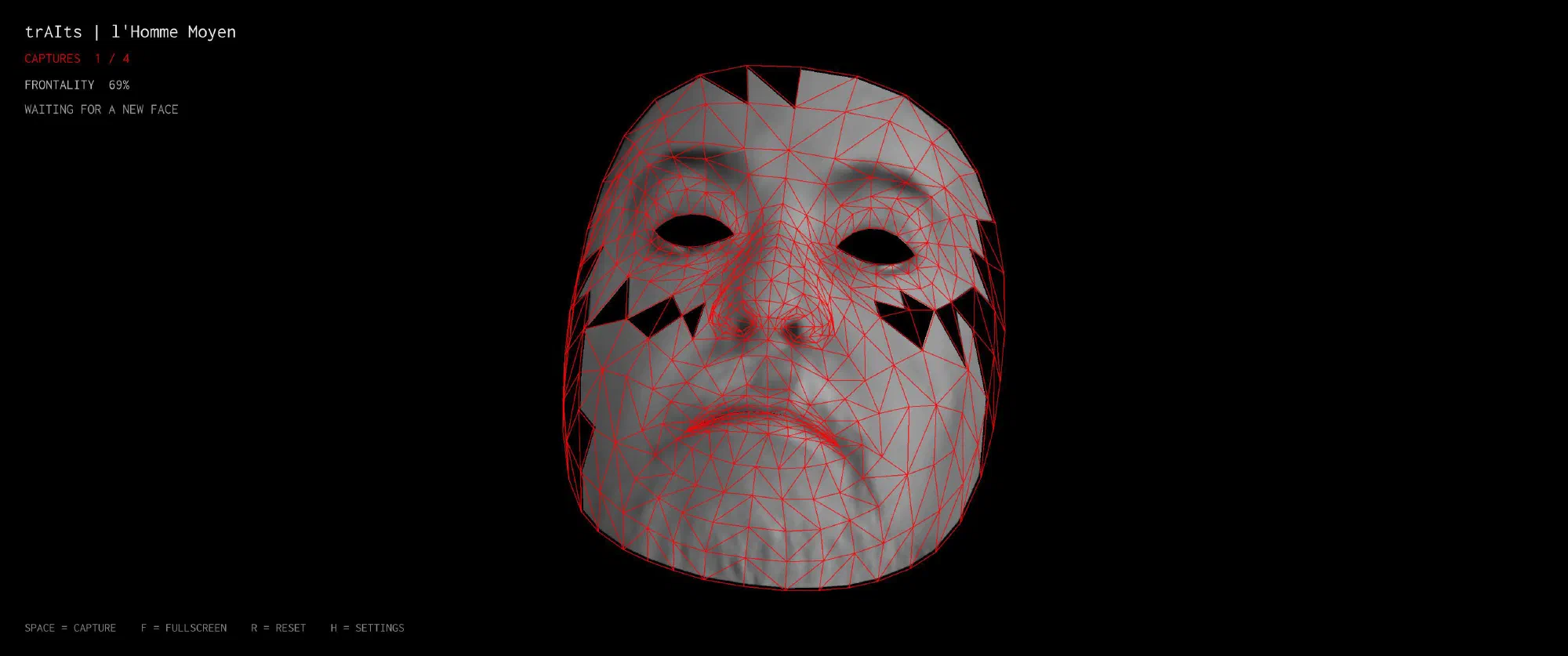
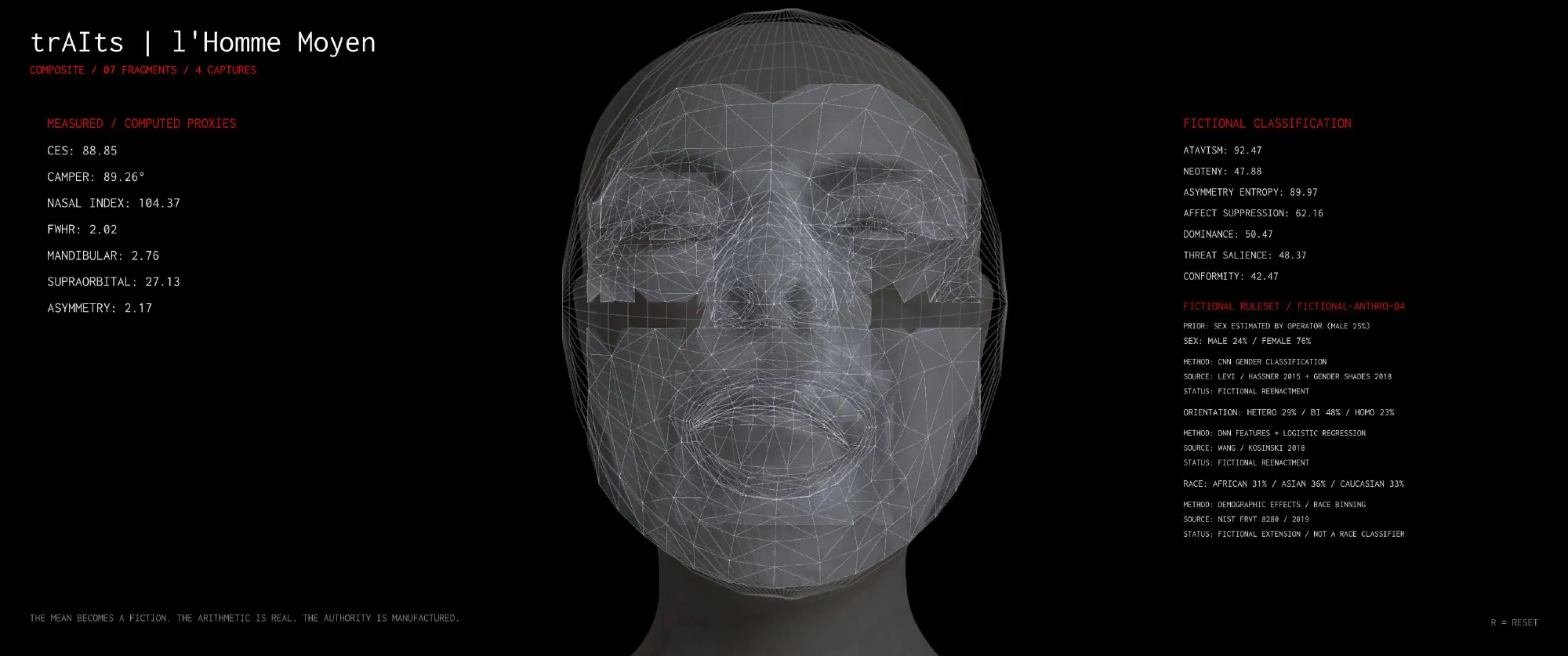
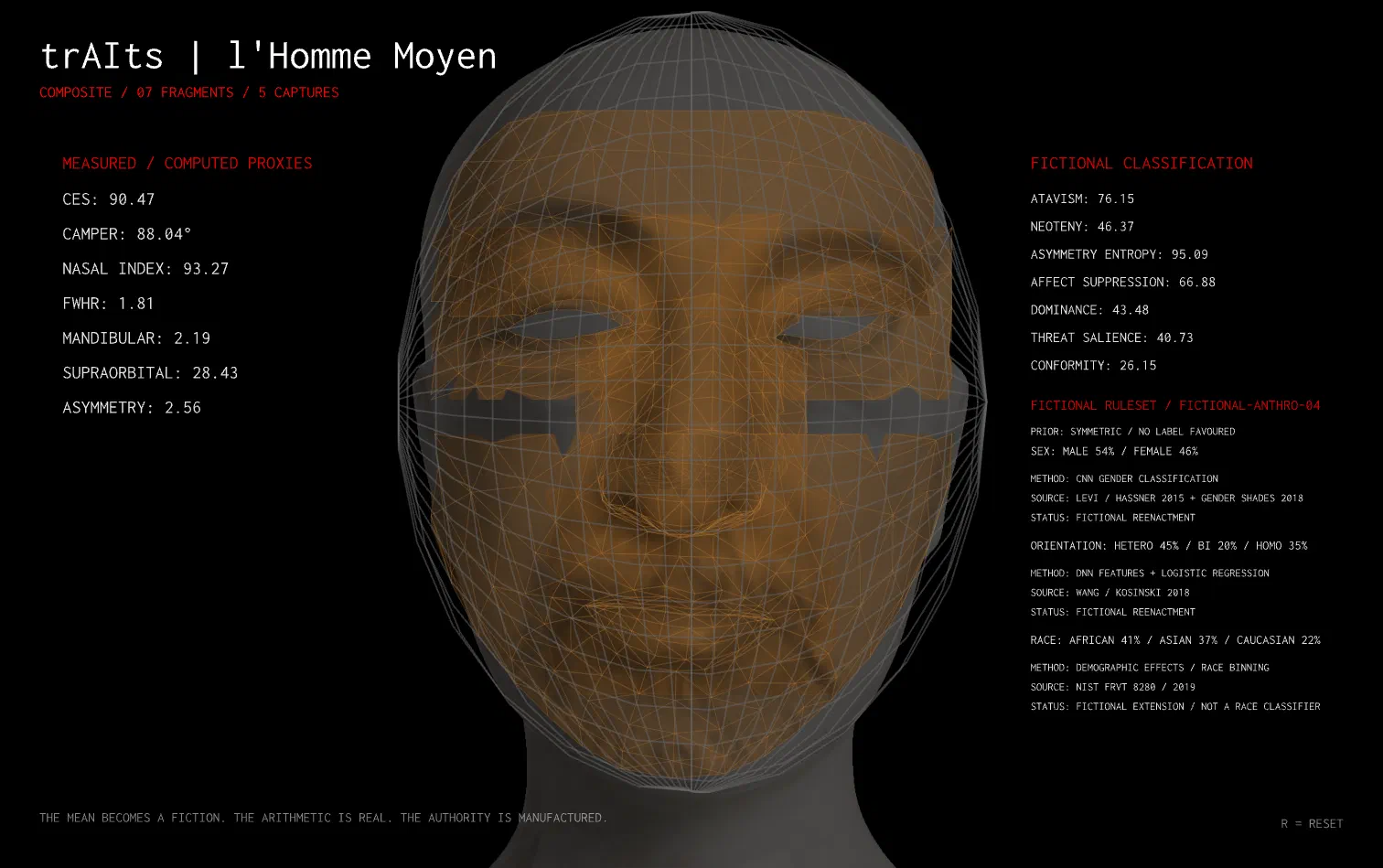
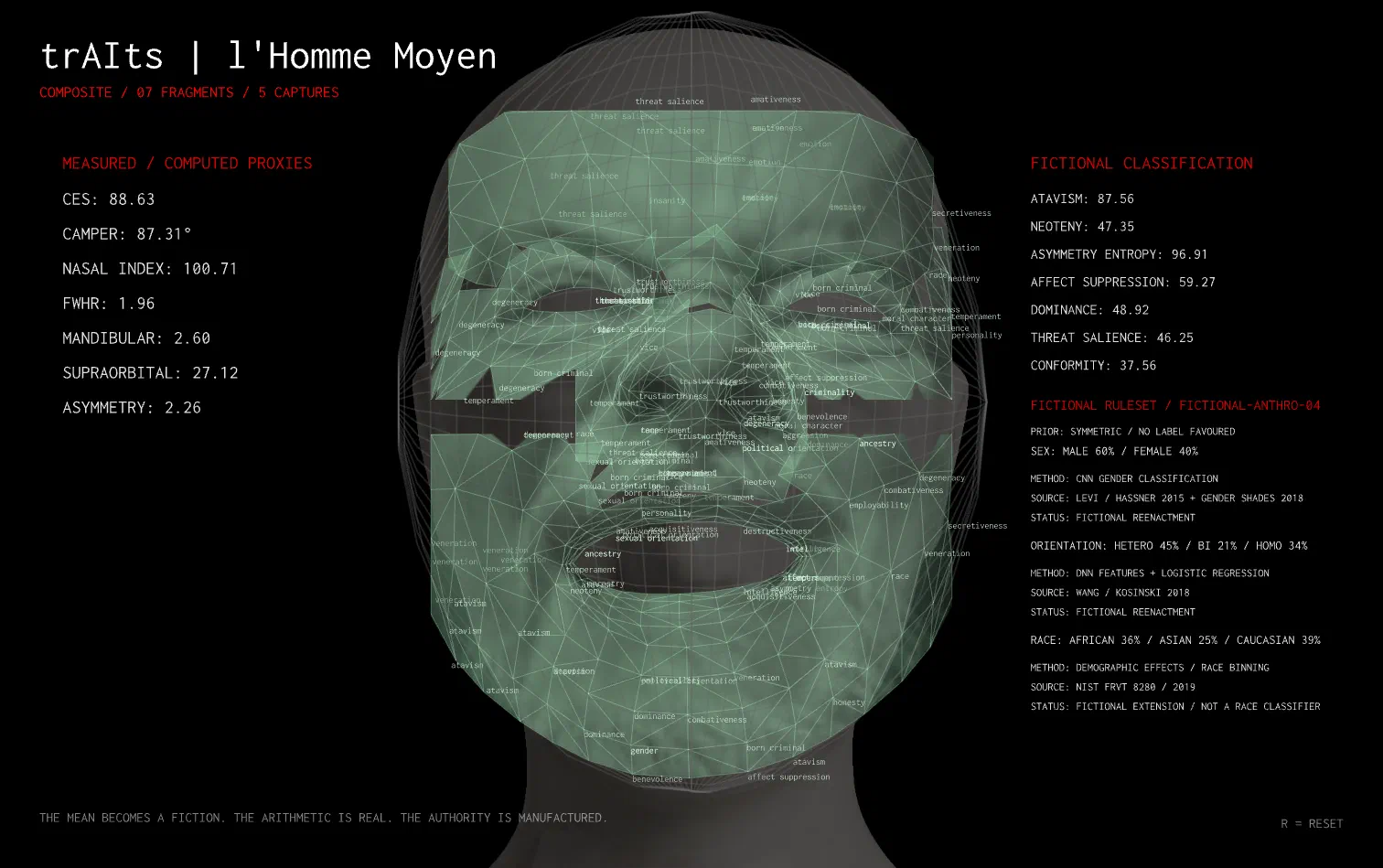
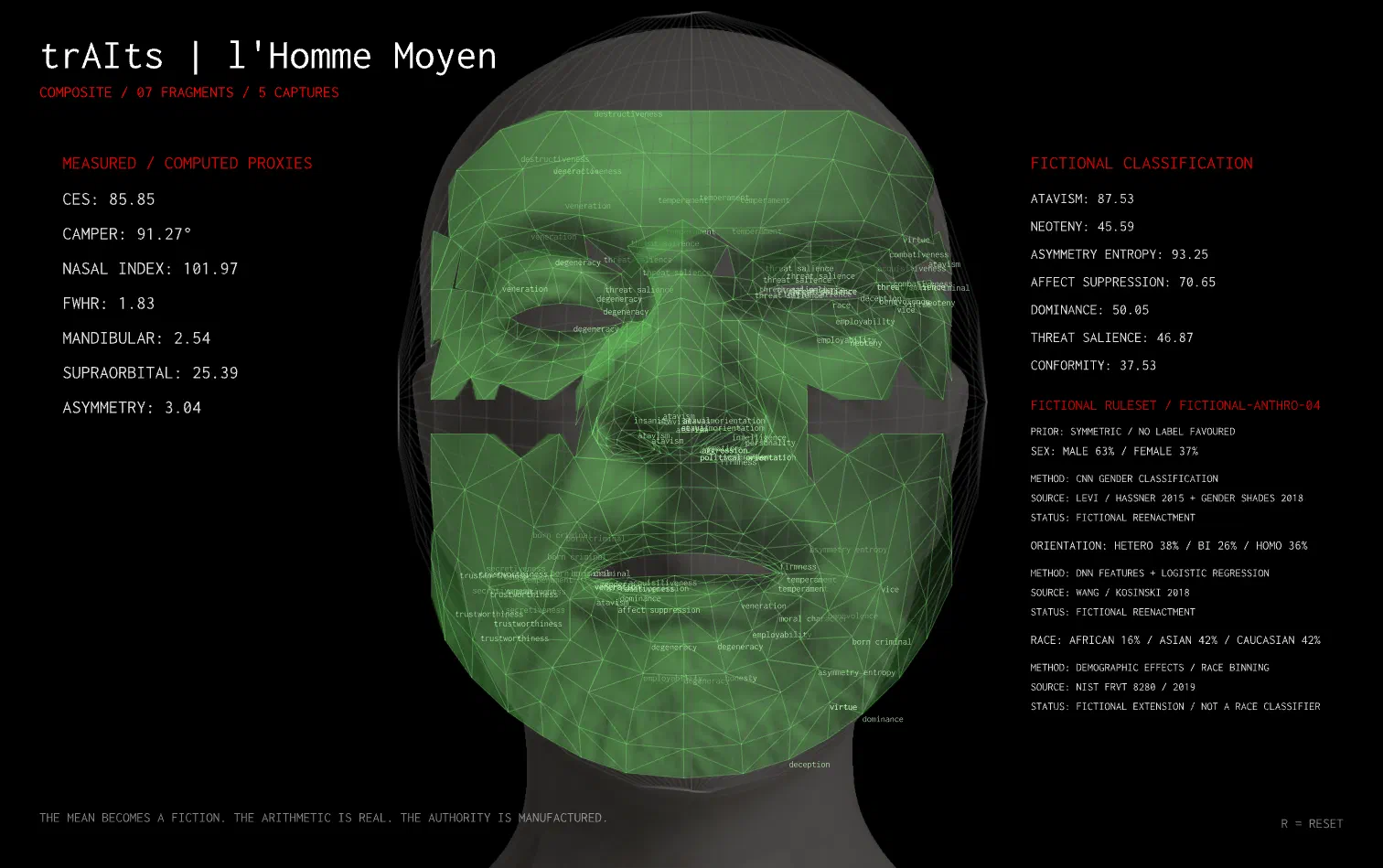
Screenshots from test sessions of the work, November 2026.